1. What is Jira?
Originally built in 2002 using Atlassian as a bug-tracking engine for software developers, Jira has developed into the organisation’s benchmark for Agile project management and work tracking. Over the past two decades, it has transformed from a developer-focused ticketing system into an organizational operating system used throughout engineering, product management, DevOps, IT service management (via Jira Service Management), and business operations.
However, Jira’s finest power—its close-to-countless configurability—is also its most common criticism. Teams often battle with steep learning curves, cluttered workflows, and administrative overhead. At the same time, Atlassian has heavily modernized the platform by rolling out Atlassian Intelligence, Rovo AI marketers, and cross-tool knowledge graphing. This review provides an honest, hands-on look at Jira’s core abilities, pricing structure, pros, cons, and contemporary options.
2. Quick Verdict & Key Specifications
Jira remains the undisputed marketplace leader for software engineering, product delivery, and cross-functional Agile workflows. Its local Scrum/Kanban boards, Jira Query Language (JQL), no-code automation engine, and deep Git integrations are unmatched. However, for non-technical teams or lightweight commercial enterprise tasks, Jira is regularly overbuilt, requiring devoted administration and sizable onboarding that lighter gear avoids.
| Specification | Details |
|---|---|
| Product Name | Jira (by Atlassian) |
| Primary Category | Agile Project Management, Issue Tracking, and Work Management Suite |
| Best For | Software engineering teams, DevOps organizations, product managers, and enterprise IT departments |
| Starting Price | Free (up to 10 users); Standard tier starts at ~$8.15/user/month (tiered by team size) |
| Key Standout Tech | Jira Query Language (JQL), Advanced Roadmaps, native Scrum/Kanban boards, Atlassian Intelligence, and Rovo AI Agents |
| Deployment Options | Cloud (Atlassian Cloud) and Data Center (Self-managed enterprise) |
| Integrations | 3,000+ Atlassian Marketplace apps (GitHub, GitLab, Bitbucket, Slack, Confluence, Figma, Zendesk) |
| TEKVERIQ Rating | 4.5 / 5 ⭐⭐⭐⭐⭐ |
3. Jira Dashboard and Core Features
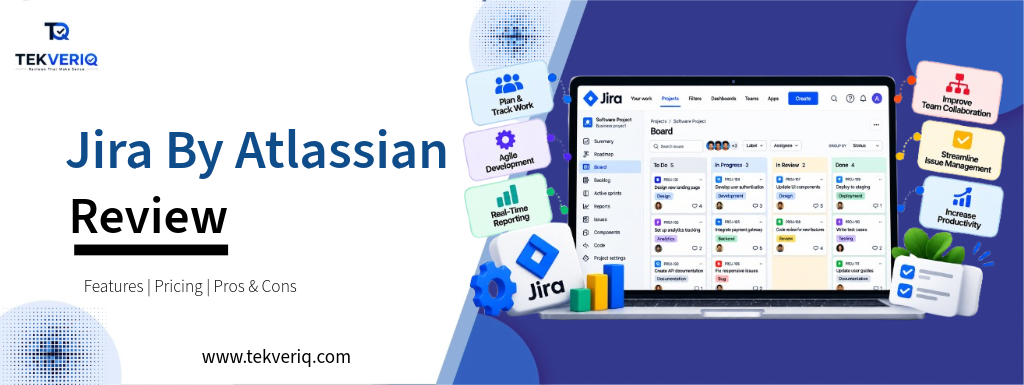
Jira structures project delivery around custom issue hierarchies (Epics, Stories, Tasks, Bugs, and Subtasks) supported by several core modules:
1. Agile Boards: Scrum and Kanban
Jira is purpose-built around Agile methodologies:
- Scrum Boards: Teams can plan sprints, allocate story points, tune speed charts, and generate real-time burndown/burnup graphs.
- Kanban Boards: Continuous-flow groups can set Work-In-Progress (WIP) limits in step with columns, visualize bottlenecks, and customize swimlanes by using assignee, priority, or custom epics.
- Backlog Grooming: Drag-and-drop backlog prioritization permits product owners to nest stories within epics, estimate effort, and map upcoming release versions.
2. Advanced Workflow Customization & JQL
Unlike lightweight project boards that offer only basic “To Do / Doing / Done” stages, Jira enables custom state-machine engineering:
- Workflow Designer: Visual graph builder to create statuses, transition regulations, computerized validators (e.G., “can not transition to Done without a QA sign-off”), and permission-based put-up capabilities.
- Jira Query Language (JQL): An SQL-like search language that lets customers query work across initiatives with precision (e.G., project = ENG AND status was “In Review” by using currentUser(), AND fixVersion is EMPTY). Saved JQL filters for Energy custom team dashboards and executive widgets.
3. Native Automation
Jira features a built-in, no-code automation engine that runs on a “When [Trigger] If [Condition] Then [Action]” model:
- Automatically closes parent tasks when all subtasks attain “Done.”
- Synchronizes ticket statuses with Git commits, pull requests, and department deployments.
- Reassigns incoming tickets based on group workload, time zones, or trouble issue tags.
4. Atlassian Intelligence & Rovo AI
Atlassian has embedded generative AI and multi-agent intelligence directly into the issue lifecycle:
- Natural Language to JQL: Users can type questions in simple English (e.G., “show me high-priority bugs opened this sprint”) and Jira auto-generates the corresponding JQL code.
- Work Breakdown: Breaks big epics down into suggested sub-tasks and reputation criteria with one click.
- Thread Summarization: Generates short summaries of sprawling discussion threads on lengthy-lived incident or characteristic tickets.
- Rovo Agents: Autonomous AI agents that can be assigned tasks or @mentioned in comments to pull facts across Jira, Confluence, Slack, and Google Drive.
5. Timelines & Cross-Team Roadmaps
Available on Premium and Enterprise tiers, Advanced Roadmaps aggregates dependencies across multiple engineering squads. Teams can balance capacity in opposition to release time limits, run situation planning, and spot blockers earlier than code freezes.
4. Jira’s Pricing and Plans
Atlassian prices Jira Cloud on a per-user sliding scale (per-seat costs decrease as user tiers expand):
| Plan Tier | Approximate Cost (Billed Monthly/Annually) | User Limit | Key Inclusions & Limits |
|---|---|---|---|
| Free | $0 (Free forever) | Up to 10 users | Scrum/Kanban boards, basic roadmaps, 2 GB storage, community support, 100 automation runs/mo |
| Standard | ~$8.15 / user / month | Up to 35,000 users | User roles & granular permissions, 250 GB storage, audit logs, standard business-hours support |
| Premium | ~$16.00 / user / month | Up to 35,000 users | Advanced Roadmaps (cross-project), unlimited storage, 24/7 priority support, 99.9% uptime SLA, advanced AI work breakdown |
| Enterprise | Custom quote (Annual) | Unlimited | Multiple Jira instances/sites, Atlassian Analytics & Data Lake, 99.95% uptime SLA, centralized user provisioning (Atlassian Guard) |
5. Pros and Cons
Pros
- Unmatched Agile Depth: Built from the ground up for Scrum, Kanban, velocity monitoring, and launch control.
- Developer Ecosystem: Native, bidirectional integration with GitHub, GitLab, Bitbucket, CircleCI, and Docker.
- Extensive Extensibility: With 3,000+ Marketplace plugins and REST APIs, Jira can adapt to nearly any employer tech stack.
- JQL Search Power: Offers the strongest querying and filtering engine of any project management tool.
Cons
- Steep Learning Curve: New users often find the terminology, multi-level permissions, and board schemes overwhelming.
- Administrative Burden: Large teams often require a dedicated Jira Administrator to clean up redundant custom fields, workflow bloat, and stale notification schemes.
- Speed & Perceived Clunkiness: Despite cloud performance optimizations, heavy tickets loaded with custom fields and historic changelogs can feel slow compared to fashionable, minimalist alternatives.
- Cost Stacking: Premium functions and important third-party market apps compound monthly licensing expenses rapidly.
6. Jira’s Alternatives
- Linear: The leading developer-favored tool for high-velocity, opinionated problem tracking. It is faster, sleeker, and removes administrative bloat, though it offers less enterprise customization than Jira.
- ClickUp: An all-in-one platform covering docs, whiteboards, goals, and tasks at lower price points; ideal for teams seeking wide functionality in place of deep Agile governance.
- Asana: The favored alternative for non-technical groups, marketing departments, and cross-functional operations that value visible workflows over dash speed charts and code deployments.
- Monday.Com: Excellent for non-technical project tracking, client operations, and executive visibility with minimal configuration necessities.
- GitHub Projects / GitLab Issues: Ideal for engineering-centric startups that choose to keep all issue tracking immediately embedded next to their source code repositories.
7. Third-Party Platform Ratings
| Review Platform | Verified Rating | Total Reviews Analyzed | Key User Highlights |
|---|---|---|---|
| G2 | 4.3 / 5 ★ | 6,000+ Reviews | Lauded for deep sprint planning tools, sprint burndown clarity, and enterprise permission governance; users frequently cite workflow configuration complexity and interface density. |
| Capterra | 4.5 / 5 ★ | 14,000+ Reviews | Highly rated for ticket traceability, cross-team transparency, and Git repository linking; common complaints center on per-seat pricing and the steep initial learning curve. |
| TrustRadius | 8.2 / 10 ★ | 3,200+ Reviews | Highlighted as an enterprise staple for release management and JQL filtering; reviewers advise establishing strict instance governance early to avoid scheme bloat. |
8. Final Verdict
TEKVERIQ Final Verdict: 4.5 / 5.0 ⭐
Jira isn’t always designed to be a lightweight task checklist; it is an industrial-strength engine built for structured product shipping.
If your organisation ships software, coordinates more than one development squad, adheres to Scrum or Kanban frameworks, and requires auditable compliance, Jira remains the most capable and extensible platform in the marketplace. However, if your team mostly coordinates popular enterprise projects, creative marketing campaigns, or fundamental agency tasks, deploying Jira introduces unnecessary administrative friction—making lighter alternatives like Asana, ClickUp, or Linear a much more productive choice.