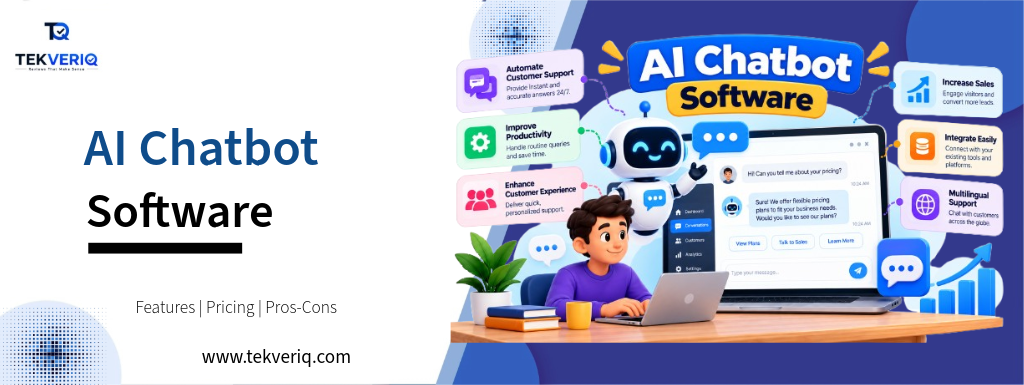
Customer support bottlenecks and rigid, rule-based, totally selection trees have elevated the shift toward intelligent conversational agents. Early website chat widgets relied on static keyword triggers (e.g., typing “return” to receive a static link to a policy page), whereas modern AI chatbot software is autonomous, context-aware operational agents.
Powered by Large Language Models (LLMs), Retrieval-Augmented Generation (RAG), and bidirectional API tool execution, current conversational platforms do a whole lot more than answer fundamental FAQs: they resolve billing disputes, process e-commerce returns, agenda subject visits, and coordinate multi-system workflows without human intervention.
Whether you’re looking for an off-the-shelf support bot for a web storefront or an enterprise orchestration platform integrated with your CRM and ERP, this guide breaks down the core structure, top platforms, pricing tiers, and selection criteria.
Quick Comparison: Top AI Chatbot Platforms at a Glance
| Platform | Primary Sweet Spot | Starting Price | Deployment Channels | Key Differentiator |
|---|---|---|---|---|
| Intercom (Fin AI) | Mid-market & enterprise customer service | $29/seat/mo + $0.99/resolution | Web, iOS, Android, WhatsApp, Messenger | Outcome-based resolution pricing model; deep helpdesk integration |
| Zendesk AI | High-volume multi-channel enterprise support | From 55–115 / agent / month | Web, Mobile, Email, SMS, Social channels | Pre-trained intent models across billions of historical customer tickets |
| Botpress | Developer-friendly conversational workflows | Free tier; paid from ~$495/mo or usage-based | Web, WhatsApp, Telegram, Slack, Zapier | Visual flow canvas paired with autonomous LLM reasoning nodes |
| Voiceflow | Cross-functional conversation design & prototyping | Free tier; Teams from ~$50 / editor / mo | Web widget, custom API, IVR voice | Collaborative canvas for designing, testing, and shipping complex agent logic |
| Tidio (Lyro AI) | SMB e-commerce & Shopify merchants | Free tier; paid from ~$29 to $39 / mo | Web, Instagram, Messenger, WhatsApp | Rapid 15-minute setup with direct Shopify inventory/order sync |
How Modern AI Chatbot Software Works: The 4-Layer Architecture
Unlike legacy script bots that broke whenever a user introduced a typo or colloquial phrase, cutting-edge AI chatbot engines perform throughout a 4-stage cognitive pipeline:
- Perception & Natural Language Processing (NLP): Converts unstructured user textual content or voice into a semantic motive, detecting nuanced emotions, language, and context across prolonged conversational turns.
- Retrieval-Augmented Generation (RAG): The version queries vector databases containing verified company manuals, technical FAQs, and internal documentation, grounding its solutions in inner statistics to eliminate hallucinations.
- Tool Calling & API Execution: Autonomous marketers engage with external software. If a customer asks, “Where is my order #54321?”, the bot queries the logistics API, retrieves monitoring records, and displays the tracking link natively in chat.
- Safety Guardrails & Human-in-the-Loop: Safety monitors review generated outputs before delivery to clean Personally Identifiable Information (PII) and ensure that solutions comply with regulatory standards. When sentiment triggers indicate customer frustration, the machine routes the overall chat records seamlessly to a live agent.
1. Intercom (Fin AI Agent): Best for Enterprise Resolution Efficiency
Intercom converted the consumer messaging panorama and has solidified its management through Fin AI, an enterprise-grade agent built on OpenAI’s underlying models. Rather than charging entirely for seat licenses, Intercom pioneered an outcome-aligned model: clients pay for effectively resolved conversations.
Key Capabilities
- Resolution Engine: Resolves common queries immediately using your Zendesk, Notion, or Intercom knowledge bases, and mentions specific reference resources directly to the user.
- Fin AI Copilot: Acts as an inner assistant for human support dealers, auto-composing responses, summarizing long price tag histories, and suggesting troubleshooting steps.
- Custom Routing Workflows: Automatically routes complex technical or billing issues to specialised human teams based on customer account value and sentiment.
Pricing Structure
- Base Platform: Starts at 29-39 per seat/month (Essential/Advanced tiers).
- Usage Fee: $0.99 per successful resolution performed by using Fin AI (described as a verbal exchange where the client confirms a decision or exits without inquiring for a human).
Pros & Cons
- Pros: Highly correct RAG grounding with minimum hallucinations; seamless hybrid bot-to-human workflows.
- Cons: High-volume operations face variable monthly payments below the $0.99/resolution utilization version.
2. Zendesk AI: Best for Established Enterprise Service Desks
Zendesk includes AI in its enterprise ticketing ecosystem, training its machine learning models on billions of real-world global customer support interactions.
Key Capabilities
- Pre-Trained Industry Intents: Recognizes client cause out of the box (e.g., transport delays, subscription cancellations, warranty inquiries) without requiring manual phrase mapping.
- Macro Suggestions & Triage: Automatically tags tickets, routes requests by priority, and indicates applicable macro responses to human agents.
- Omnichannel Continuity: Maintains a complete communication context regardless of whether the client interacts via email, web widget, WhatsApp, or smartphone.
Pricing Structure
- Suite Team / Growth: Starts at 55-89 / agent / month (billed annually).
- Advanced AI Add-on: Available on professional and corporate ranges for an additional ~$50 / agent / month.
Pros & Cons
- Pros: Enterprise-level reliability and statistics compliance (SOC 2, HIPAA, GDPR); huge reporting analytics.
- Cons: Substantial funding required for smaller groups; configuration requires dedicated administrative knowledge.
3. Botpress: Best for Developers and Custom Conversational Logic
Botpress is a next-generation bot-building platform designed for developers and product teams that require deep control over state machines, custom code execution, and multi-model routing.
Key Capabilities
- Hybrid Flow Canvas: Combines deterministic, visual flowcharts with open-ended LLM self-reliant reasoning steps.
- Code Sandbox: Execute inline JavaScript, construct custom webhook endpoints, and query proprietary outside databases at once within conversation branches.
- Multi-LLM Flexibility: Switch seamlessly between models from OpenAI, Anthropic, and open-source models based on speed, task complexity, and value considerations.
Pricing Structure
- Free Plan: Free tier includes generous, simple message credits and unlimited bot builds.
- Pay-As-You-Go / Team: Base plans from $495/month for dedicated infrastructure, or tiered consumption pricing for API execution tokens.
Pros & Cons
- Pros: High engineering flexibility; removes vendor lock-in with multiple LLM backends; active developer network.
- Cons: Requires technical literacy (JavaScript/API principles) to liberate its full feature potential.
4. Voiceflow: Best for Conversation Design, Testing & Prototyping
Voiceflow began as an interface design tool for voice assistants (Alexa/Google Assistant) and has developed into an industry-standard collaborative canvas for architecting, prototyping, and deploying conversational AI agents.
Key Capabilities
- Collaborative Canvas: Product managers, copywriters, and developers can co-design conversation trees and agent behaviors in real time, just like Figma.
- Knowledge Base Ingestion: Upload URLs, PDFs, and Markdown documents to test RAG accuracy inside an interactive prototyping sandbox.
- Headless Deployment: Export conversational logic as easy JSON or connect directly through Voiceflow’s Runtime API on your proprietary front-end web apps and voice systems.
Pricing Structure
- Free (Sandbox): Up to 2 team individuals, 100K AI tokens per month, and core prototyping tools.
- Teams: $50 / editor / month (billed annually); consists of 1M month-to-month tokens, unlimited projects, and API access.
- Enterprise: Custom quote; SSO, enterprise security, and custom token limits.
Pros & Cons
- Pros: Best-in-class interface for conversational UX design; visible prototyping accelerates stakeholder alignment.
- Cons: Headless API deployment requires internal development teams to combine into custom web frameworks.
5. Tidio (Lyro AI): Best AI Chatbot for Small E-Commerce & Shopify
Tidio presents an intuitive live chat and conversational AI suite tailored specifically for direct-to-consumer (DTC) brands, small groups, and boutique e-commerce stores.
Key Capabilities
- Lyro AI Engine: Learns brand FAQ solutions within minutes by scanning website URLs and support articles, resolving up to 70% of preferred customer questions.
- Direct Shopify & WooCommerce Sync: Check real-time inventory balances, pull transport statuses, and initiate cart-abandonment recovery automations.
- Unified Live Chat Widget: Combines automatic AI responses with live agent chat, Instagram DMs, and Facebook Messenger on one shared inbox.
Pricing Structure
- Free Plan: Basic live chat with restricted month-to-month visitor quotas.
- Starter / Growth: Paid plans range from ~$29 to $59 / month based on conversation volumes.
- Lyro AI Add-on: Usage ranges based on conversations handled (e.g., $39/month for 50 AI-resolved conversations).
Pros & Cons
- Pros: Zero-code installation via the Shopify App Store; transparent interface; accessible pricing for small businesses.
- Cons: Lacks enterprise multi-department routing, custom API sandboxes, and advanced protection configurations.
Essential Features Checklist for Evaluating Chatbot Software
When vetting conversational software in your tech stack, compare prospective vendors against these operational standards:
- Retrieval-Augmented Generation (RAG): Ingests internal assist documents, URLs, and PDFs with quotation monitoring.
- Multi-Channel Presence: Deploys seamlessly throughout Web, WhatsApp, Instagram, SMS, and Mobile SDKs.
- Bidirectional Tool Calling: Capable of triggering API actions (updating CRMs, processing refunds, checking inventory).
- Contextual Memory Management: Maintains state throughout long dialogues and remembers the user’s return alternatives.
- Hallucination Guardrails: Prevents off-topic banter, enforces brand safety regulations, and suppresses sensitive statistics.
- Native Live-Agent Escalation: Seamlessly passes conversation history and context to human representatives.
- Transparent Usage Pricing: Clear distinction among base seat costs, LLM token charges, and per-resolution fees.
Final Decision Framework: Which AI Chatbot Software Fits Your Goals?
Selecting the right platform comes down to your integration requirements, technical assets, and price range:
- For Turnkey Customer Support (Mid-Market to Enterprise): Deploy Intercom (Fin AI) or Zendesk AI to deflect tier-one support tickets and empower human agents with automated ticket summaries and macro pointers.
- For Custom Developer Architecture & Private Clouds: Choose Botpress to build tailor-made state machines and manage personal LLM routing with full code control.
- For Product Teams & Conversational UX Designers: Use Voiceflow to prototype, validate, and collaborate on complex dialog flows before deploying through APIs.
- For Small Retail & E-Commerce: Use Tidio to get automated order tracking and FAQ decision to stay on your website in under an hour.
By choosing a solution that combines reliable RAG grounding with bidirectional API execution, you can deploy an AI agent that eliminates guide-support strain and delivers measurable operational value around the clock.