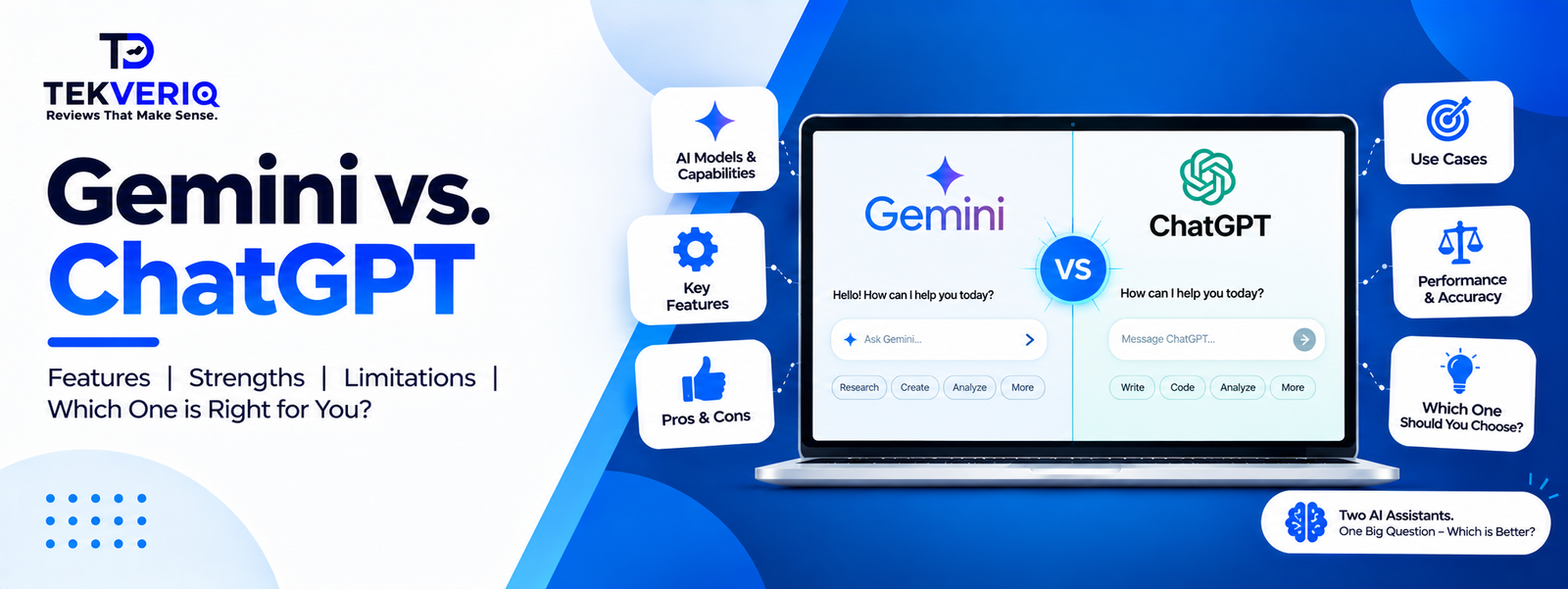
Google Gemini vs. ChatGPT are the two titans that dominate the generative AI space. Both platforms have developed into complex, fully multimodal ecosystems that can process text, photos, audio, video, and code, much beyond basic text-based chatbots.
Your workflow, tech stack, and main use cases all play a major role in selecting the best helper. A thorough comparison of Gemini and ChatGPT’s capabilities, cost structures, and best use cases can be found below.
1. Core Architecture and Features
While both tools can accomplish a wide array of daily tasks, their underlying philosophies and toolsets create distinct user experiences.
Google Gemini
- Native Multimodality & Context Window: Gemini was designed from the ground up to handle several kinds of data at once. Users can upload whole codebases, hours of video, or hundreds of pages of financial reports at once because of its enormous context window (up to one million+ tokens).
- Ecosystem Integration: The Google Workspace ecosystem is intricately linked to Gemini. It functions as a native sidekick in Gmail, Google Docs, Sheets, and Drive, enabling you to easily create emails, summarise documents, and extract data.
- Real-Time Information: Gemini, supported by Google Search, is excellent at presenting current web data, supported by unambiguous source citations that make fact-checking easier.
- Media Generation: It uses Veo to create videos and Imagen to create images.
OpenAI ChatGPT
- Advanced Reasoning & Conversational Polish: ChatGPT is well known for its strong performance on challenging, multi-step reasoning, sophisticated coding, and debugging jobs. It is powered by advanced GPT models. It frequently has a conversational, organic, and well-structured writing style.
- Custom GPTs & Ecosystem: ChatGPT has a vast marketplace of Custom GPTs, which are user-made micro-assistants designed for specific processes, such as language tutors or specialised legal analysis.
- Tool Integration: It has powerful built-in capabilities such as code interpreters, online browsing, and advanced data analysis. In terms of media, it combines image generation with programs like Sora for the production of short videos.
2. Pricing Comparison
Both providers offer free tiers alongside premium subscription models tailored for power users, professionals, and enterprises.
| Tier | Google Gemini | OpenAI ChatGPT |
|---|---|---|
| Free Plan | Access to standard models, web integration, and basic multimodal features (including image creation). | Access to core GPT models, limited custom GPT usage, web browsing, and restricted daily image/advanced tool allowances. |
| Pro / Plus Plan | ~$20/month (Gemini Advanced / Google One AI Premium): Unlocks frontier models, 1M+ token context windows, and direct integration inside Google Workspace apps. | ~$20/month (ChatGPT Plus): Unlocks higher message caps, advanced reasoning models, deep research tools, agent features, and priority access. |
| Enterprise / Team | Scaled workspace pricing integrated directly through Google Cloud / Google Workspace admin consoles. | Team and Enterprise tiers featuring dedicated workspace controls, enhanced data privacy, and higher compute limits. |
3. Key Use Cases: When to Use Which?
Choose Google Gemini If:
- You live in Google Workspace: Gemini’s built-in sidebar integration saves a significant amount of time if you often draft emails in Gmail, manage data in Sheets, or summarise lengthy PDFs in Google Drive.
- You must examine large files: Gemini is unparalleled whether you need to load a multi-hour film or a 500-page handbook into the chat and ask specific questions about it because of its industry-leading context window.
- Priorities include fact-checking and research foundation: Gemini’s direct connection to Google Search facilitates the easy and transparent process of finding online references and verifying current occurrences.
Choose OpenAI ChatGPT If:
- You require deep logical reasoning or coding support: ChatGPT has a slight advantage for complicated multi-file debugging, heavy-duty software engineering, and complex logical problem-solving.
- You want customisable mini-assistants: ChatGPT’s GPT Store is a great resource if you depend on community-built specialised workflows or wish to create a private Custom GPT trained on proprietary materials.
- You value conversational and creative nuance: ChatGPT produces polished outcomes right out of the box for marketing copy, creative narrative, or iterative brainstorming where tone and stylistic diversity matter.
4. API and Developer Ecosystems
For developers, startups, and enterprises building custom apps, the underlying API economics and tooling differ significantly.
Google Gemini API:
- Massive Context Handling: Using the API, developers can easily query large documents or multi-hour audio/video recordings.
- Cost-Effectiveness: For high-volume, repeated writing or translation projects, Gemini’s Flash models and tiered pricing provide incredibly affordable solutions.
- Google Cloud Synergy: It is a seamless option for teams already growing on Google’s cloud infrastructure because of its deep integration with Google Cloud, Firebase, BigQuery, and Vertex AI.
OpenAI API:
- Advanced Agentic Tools: OpenAI offers reliable endpoints for function calling, fine-tuning, assistants, and structured JSON outputs.
- Flexibility & Ecosystem: Because of its comprehensive documentation and quick implementation of cutting-edge reasoning checkpoints, OpenAI continues to be a mainstay for third-party developer frameworks, mobile wrappers, and multi-agent systems.
5. Voice, Real-Time Audio, and Multimodal Capabilities
Interacting with AI has shifted far beyond typing text into a box.
- Gemini (Native Multimodality): Gemini is capable of processing both visual and auditory data. It is incredibly quick for lifelike interaction because of its live voice features, which enable smooth, interruptible conversational sessions where the model may “see” through your phone’s camera or listen to live audio streams in real time.
- ChatGPT (Advanced Voice & Vision): ChatGPT has a low-latency, highly expressive Advanced Voice Mode that naturally catches accents, vocal inflections, and emotional cues. When combined with its vision skills, you can instantly solve math problems or debug code by sharing your screen or camera feed.
6. Privacy, Security, and Enterprise Compliance
How enterprise data is handled is a primary deciding factor for corporate adoption.
- Google Workspace & Cloud Security: Data entered into Gemini Workspace or Google Cloud is not utilised to train public models; Google operates under strong enterprise privacy guarantees for business accounts. Additionally, it has advanced regulatory compliance, such as FedRAMP High and HIPAA capabilities.
- OpenAI Enterprise Controls: To protect confidential company code and documents, OpenAI’s Team and Enterprise tiers provide zero-data retention rules for training, specialised administrative controls, domain verification, and SOC 2 Type II compliance.
Updated Feature Matrix Quick Reference
| Feature Category | Google Gemini | OpenAI ChatGPT |
|---|---|---|
| Max Context Window | Up to 1M+ tokens (ideal for whole codebases/books) | Smaller standard conversational context, optimized for fast logical execution |
| Ecosystem Sync | Google Workspace (Docs, Gmail, Drive, Android) | Custom GPT Store, third-party integrations, developer tools |
| Media Generation | Imagen (Images) & Veo (Video) | DALL-E (Images) & Sora (Video previews) |
| Enterprise Compliance | Google Cloud / Workspace security & FedRAMP High | SOC 2 Type II, dedicated Enterprise privacy guardrails |
The Bottom Line
Neither tool is “better” in every situation; they work well in different contexts. For complex reasoning, polished creative writing, and personalised bot ecosystems, ChatGPT is still the preferred powerhouse. For those who are heavily involved in the Google ecosystem and need real-time grounded research and extensive document analysis, Google Gemini stands out as the best productivity partner. Depending on the particular requirements of the task at hand, many power users ultimately decide to employ both.