Data inaccuracies, regulatory issues, and administrative weariness are frequently caused by managing shift-based workforces, complex worldwide payroll, and human resources across disparate platforms. Dayforce HCM has become a market leader for mid-to-large businesses looking for an all-in-one solution.
Dayforce, which is well-known for its unified architecture and continuous computation engine, seeks to reduce the complexity of conventional batch payroll processing. We assess Dayforce HCM’s primary features, cost, benefits, drawbacks, and alternatives in this thorough analysis.
1. Quick Verdict & Key Specifications
| Specification | Details |
|---|---|
| Product Name | Dayforce HCM |
| Primary Category | Human Capital Management (HCM) & Global Payroll Platform |
| Best For | Mid-to-large enterprises, multi-state organizations, and shift-heavy workforces (retail, healthcare, manufacturing) needing real-time payroll and workforce management |
| Starting Price | Quote-based custom enterprise pricing (typically structured per employee per month, with implementation fees ranging based on scope) |
| Key Standout Tech | Continuous calculation payroll engine, Dayforce Wallet (on-demand pay), advanced labor scheduling, and unified single-database architecture |
| TEKVERIQ Rating | ⭐⭐⭐⭐⭐ (4.6/5) |
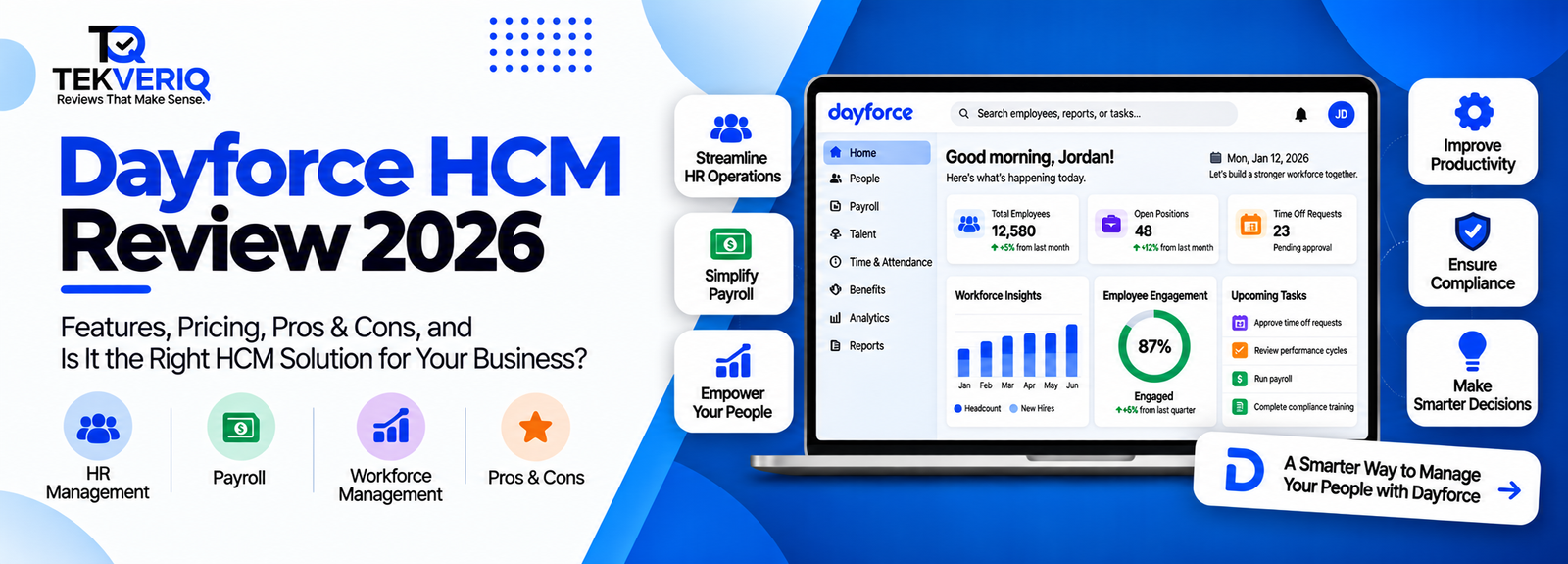
2. Dayforce HCM Dashboard and Features
Because Dayforce’s platform is based on a single-database design, data moves between modules without the need for middleware interfaces or manual synchronisation.
Essential Platform Features:
- Continuous Calculation Payroll: Dayforce essentially eliminates end-of-period payroll surprises by computing gross-to-net pay in real time as timecards, rate adjustments, or deductions are updated, in contrast to older systems that rely on overnight batch runs.
- Dayforce Wallet: A potent retention tool for hourly and shift workers, it enables workers to access already-earned wages prior to traditional paydays via a linked card or mobile app.
- Workforce Management & Scheduling: AI-optimized scheduling methods, labour forecasts, and sophisticated time tracking match labour demand with staff availability while automatically checking compliance restrictions (such as overtime and breaks).
- Core HR & Global Payroll: Automated local tax filing, onboarding portals, and thorough personnel tracking support operations in more than 200 countries worldwide as well as North America.
- Talent Management & AI Tools: Combined modules for learning management, performance evaluations, application monitoring, and AI-powered job description creators.
3. Dayforce HCM Pricing
Dayforce has an enterprise model built on quotes. The total headcount, chosen module packages (such as Core HR, Payroll, Advanced Scheduling, Talent), and implementation complexity all influence pricing.
| Plan Tier | Pricing Structure | Key Features | Best Suited For |
|---|---|---|---|
| Core HR & Payroll | Custom Quote (Per Employee / Month) | Single database core HR, continuous calculation payroll, basic time tracking, employee self-service | Organizations consolidating basic HR and payroll operations |
| Full Suite Enterprise | Custom Quote (Higher Volume Tiers) | Advanced workforce management, global payroll coverage (200+ countries), Dayforce Wallet, talent suite | Large multinational corporations and complex shift-based enterprises |
| Implementation Services | One-time Setup Quote | Professional implementation, data migration, configuration consulting (typically runs 7 to 12+ months) | Enterprises undergoing major digital HR transformations |
4. Pros and Cons
Pros
- Real-Time Payroll Accuracy: Immediate labour cost visibility is provided by continuous calculation, which removes traditional batch processing inefficiencies.
- Unified Single Database: By keeping HR, time, and pay in one location, it avoids data silos, reconciliation mistakes, and clumsy API interactions.
- Outstanding Workforce Management: Shift-based businesses greatly benefit from automated compliance regulations, geofenced mobile clock-ins, and robust scheduling.
- Dayforce Wallet Integration: Offers integrated early wage access, which significantly improves employee retention without posing a credit risk to the employer.
Cons
- Steep Learning Curve: Administrative training is necessary for several complicated navigation operations, sophisticated settings, and report builders.
- Resource-Intensive Implementation: Initial rollouts are less appropriate for smaller organisations since they demand a substantial time and financial investment.
- Customer Support Delays: When troubleshooting complex configurations, some users experience delayed response times.
5. Dayforce HCM Alternatives
Dayforce is a workforce management and enterprise payroll powerhouse; however, there are a number of alternatives that suit various business models:
- Workday HCM: Although it usually uses a more modular architecture, it is well known for its exceptional global business flexibility, deep analytics, and extensive configurability.
- UKG Pro (Ultimate Kronos Group): A formidable rival for workforce engagement and human capital management, with a focus on business culture solutions.
- Rippling: A cutting-edge, highly automated HCM and IT management platform ideal for rapidly expanding mid-market businesses that appreciate quick setup and cutting-edge API interfaces.
6. Third-Party Platform Rating
| Review Platform | Verified Rating | Total Reviews Analyzed | Key User Highlights |
|---|---|---|---|
| G2 | 4.2 / 5 ★ | 800+ Reviews | Praised for uniting HR, payroll, and scheduling into a single pane of glass, though navigation complexity is occasionally noted. |
| Capterra | 4.3 / 5 ★ | 400+ Reviews | High marks for reliability, robust mobile app self-service features, and error reduction via real-time payroll calculations. |
| SelectHub | 86 / 100 ★ | Enterprise Scale | Recognized as a top-tier choice for workforce management and continuous payroll calculation in retail, healthcare, and manufacturing. |
7. Final Verdict
TEKVERIQ Final Score: 9.2 / 10
Dayforce HCM is a game-changing investment if your company has issues with batch payroll delays and maintains a complicated, dispersed, or shift-heavy workforce. Its unified data model and continuous calculation engine offer unparalleled operational visibility. The long-term improvements in accuracy and labour efficiency make it a top option for corporate scale, even though deployment calls for patience and significant resource investment.
Final Suggestion: Strongly advised for complex organisations and mid-to-large businesses that place a high priority on advanced personnel management and real-time payroll accuracy.