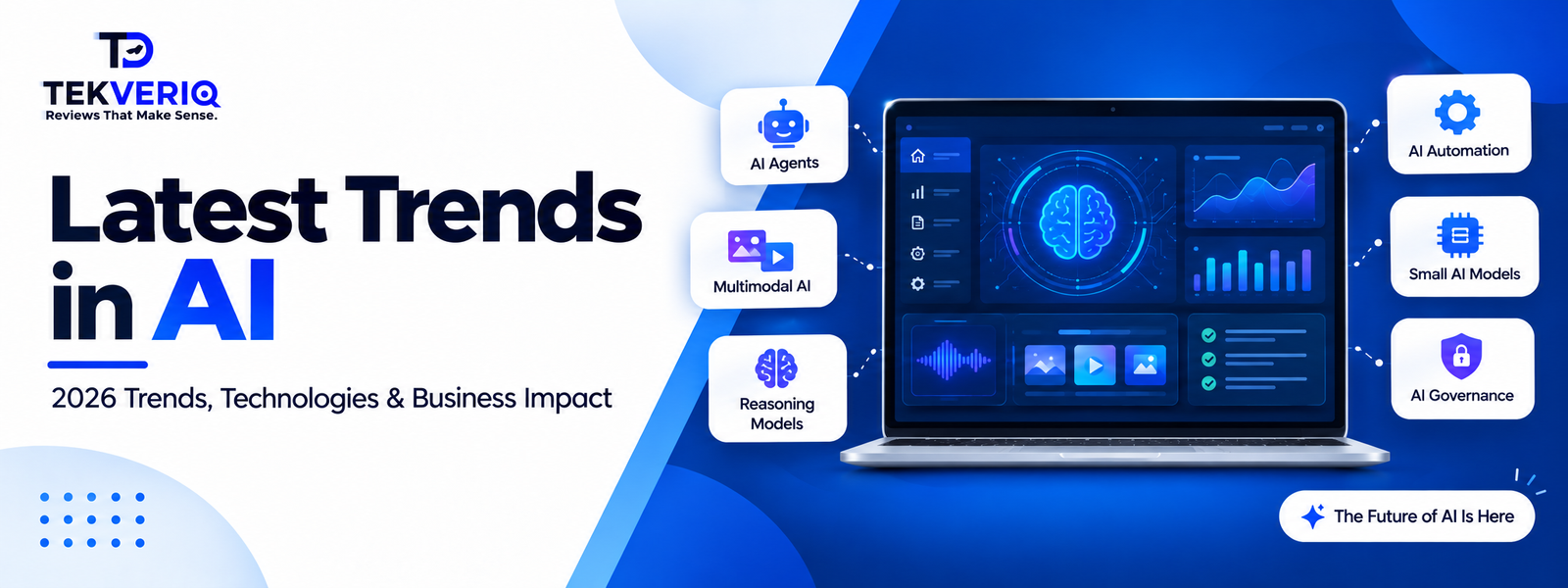
Artificial Intelligence is undergoing a massive evolutionary leap. While early breakthroughs in generative AI focused primarily on conversational responses and synthetic media creation, today’s advancements center on autonomy, system-level integration, efficiency, and real-world execution. Understanding these shifts is vital for tech leaders and creators aiming to maintain a competitive edge.
1. The Rise of Agentic AI and Autonomous Systems
The Dominant Shift in artificial intelligence is the transition from assistive prompt and response tools to Agentic AI. Rather than waiting for sequential human input, autonomous agents can independently break down complex objectives, plan multi-stage paths, call external APIs, and execute tasks with minimal supervision.
- Autonomous Tool Use: Agentic now interfaces directly with software environments browsing the web, querying enterprise databases, and running internal code.
- Self Correction & Reflection: Advanced frameworks allow models to evaluate their intermediate outputs, identify errors, and retry steps before delivering a final result.
- Multi Agent Orchestration: Specialized micro agents collaborate in swarms, where one agent drafts, another audits for compliance, and a third deploys the solution.
2. True Multimodal AI Systems
While early models handled text, images, or audio through disconnected pipelines, modern systems are built natively multimodal from the ground up.
Natively multimodal models ingest and reason across text, high-resolution video, spatial diagrams, and natural speech concurrently without converting every input to text tokens first. This enables real time conversational voice interfaces with humans like latency, emotion recognition, and precise video comprehension for robotics and automated quality control.
3. Edge AI and Smaller, Efficient Small Language Models (SLMs)
Running massive trillion parameter models in centralized cloud data centers presents latency, cost and privacy challenges. To address this, the industry has placed heavy emphasis on edgy AI and small language models (SLMs).
- On Device Execution: Highly compressed models sun locally on smartphones, PCs, and embedded automotive chips, enabling offline access and near zero latency.
- Data Privacy: Sensitive biometric and enterprise data never leaves the local device, simplifying regulatory compliance.
- Techniques Like Quantization & Distillation: Through 4-bit and 8-bit quantization and student teacher knowledge distillation, models with 3B to 8B parameters now achieve task benchmarks previously reserved for massive server side models.
4. The Acceleration of Open Source Foundation Models
Open-Source and open-weight models have narrowed the performance gap with proprietary frontier models. Frameworks and model families for open research consortia and enterprise open-source initiatives allow companies to host, fine-tune, and inspect models entirely within their private infrastructure.
This decentralization democratises access to state to the art weights, eliminates single vendor lock-in, and encourages rapid community innovation in fine-tuning strategies such as Direct Preference Optimization (DPO) and LoRA (Low-Rank Adaptation).
5. Enterprise AI Governance, Security, and Trust
As autonomous tools take on mission-critical workflows, enterprise adoption hinges on safety, explainability and rigorous compliance.
| Strategic AI Pillar | Operational Capability | Business Value & ROI Drivers |
|---|---|---|
| Agentic AI & Swarms | Multi-step task execution, automated API chaining, and self-correcting logic. |
|
| Edge AI & Small Language Models (SLMs) | Compact, quantized models (3B–8B parameters) running on local hardware or private VPCs. |
|
| Native Multimodality | Unified understanding of real-time audio, diagrams, video, and tabular data. |
|
| Open-Source & Fine-Tuned Weights | Internal deployment of open weights (LoRA/DPO fine-tuning on enterprise IP). |
|
The trajectory of artificial intelligence is clear: systems are becoming more agentic, computationally efficient, and deeply woven into hardware and software stacks. Success in this new phase belongs to organizations and developers who move beyond treating AI as a casual novelty and begin integrating domain-specific, autonomous and governed workflows into their everyday operations.
Conclusion
The modern era of artificial intelligence rewards strategic execution over raw model experimentation. Sustainable competitive advantage will not come from adopting the largest generalized models, but from building disciplines, autonomous architectures that integrate seamlessly with proprietary workflows, respect strict unit economics, and operate within robust governance frameworks.
By prioritizing smart model routing, agentic task orchestration, and domain specific fine tuning, organizations can transform AI from an unpredictable cloud expense into a high-leverage growth engine that compounds efficiency, protects sensitive data, and delivers measurable ROI.