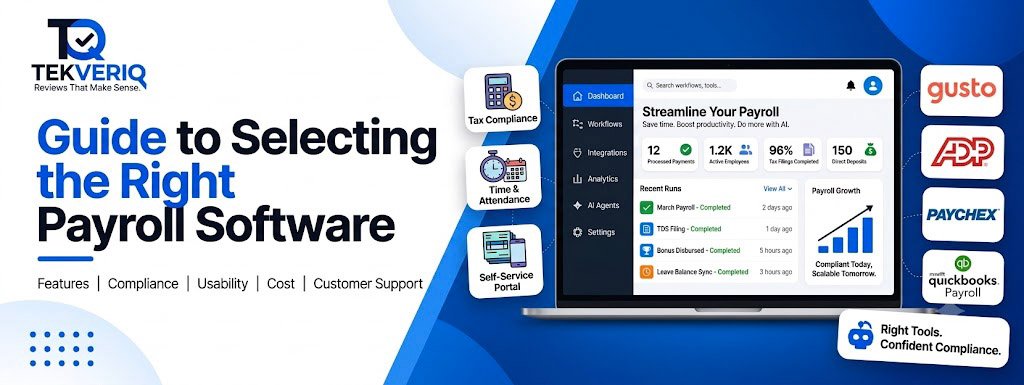
One of the most important operational choices your company can make is selecting the appropriate payroll software. Modern cloud payroll solutions have a direct impact on data security, financial accuracy, employee happiness, and statutory compliance, in addition to generating paychecks and making direct transfers.
Finding the perfect fit among the many options—which range from simple engines for startups to powerful enterprise human capital management (HCM) platforms—requires a methodical, deliberate approach.
1. Examine Your Present Payroll Procedure and Problems
Prior to examining vendor marketing pitches or software capabilities, assess how payroll already operates in your company:
- Determine bottlenecks: Do you spend days manually comparing spreadsheets and timesheets? Can human error occur in statutory calculations?
- Make a workforce map: List the different types of employees you have (full-time, part-time, contractors, hourly versus salaried workers), since different platforms focus on different types of employment arrangements.
- Establish your growth trajectory: Think about your hiring strategies. When you reach 100 people, a product that can easily manage 20 might not be scalable.
2. Must-Have Features in Modern Payroll Software
Not all payroll solutions provide the same abilities. Prioritize a platform that includes these core features:
- Automated Payroll Processing: The software should effortlessly calculate gross-to-net pay, cope with standard deductions, and account for bonuses, additional time, and pay changes.
- Tax Compliance Management: A top-tier system stays up to date with changing tax laws, profit tax filings, and statutory regulations (such as PF, ESI, TDS, and PT), minimizing the risk of costly consequences.
- Employee Self-Service (ESS) Portal: A mobile app or web portal allowing employees to view pay stubs, download tax forms (like Form sixteen), check department balances, and update personal details independently.
- Time and Attendance Integration: Seamless syncing among attendance monitoring, shift scheduling, and payroll removes manual data entry mistakes and streamlines additional time calculations.
- Robust Reporting: Customizable reporting dashboards that provide deep insights into hard work charges, payroll summaries, and audit trails.
3. Assess Integration and Scalability
Payroll is not an independent process. It needs to work seamlessly with your larger tech network.
- Software Ecosystem: To seamlessly sync ledger accounts and employee onboarding data, make sure the payroll platform interfaces with your current accounting software (such as QuickBooks, Zoho Books, or Xero) and HRIS tools.
- Future-Proofing: Select a scalable design that can handle future company reorganisation, regional expansions, and multi-location operations without requiring a disruptive migration.
4. Evaluate Security and Data Privacy
Highly sensitive data, such as bank accounts, government identities, and regular salary amounts, can be found in payroll systems. Ask important security-related questions when screening vendors:
- Does the vendor uphold high-grade encryption standards when the data is in transit and at rest, and where is the data hosted?
- Is it possible to limit sensitive financial data to authorised workers only using role-based access controls?
- Does the supplier have regular data backup and disaster recovery policies in place?
5. Calculate the Total Cost of Ownership (TCO)
Payroll companies have quite different pricing models. Look beyond the standard marketing subscription charge when evaluating costs:
- Base Subscription vs. Per-Employee Fees: Find out if your monthly billing is fixed or adjusted based on the number of active employees.
- Implementation and Setup Costs: Take into account one-time costs for training, data migration, and onboarding.
- Hidden Fees: Keep an eye out for additional costs related to bespoke reporting, off-cycle payroll runs, year-end tax filings, or premium customer service.
Payroll Software Comparison Matrix
| Software | Best For | Core Features | Pricing Structure |
|---|---|---|---|
| Zoho Payroll | Small & growing businesses within the Zoho ecosystem | Payroll automation, tax compliance, direct deposits, employee portal | Plans start around ₹1,000/month; free plan available |
| greytHR | SMEs requiring deep statutory compliance and HR integrations | Automated salary calculations, statutory deductions, mobile app, ESS portal | Tiered subscription per employee/month |
| Keka HR | Fast-growing SMBs needing modern UI and strong attendance tracking | Guided payroll runs, leave/attendance tracking, automated tax filing | Custom pricing / quote-based |
| RazorpayX Payroll | Startups wanting automated compliance and instant salary disbursements | Automated PF/ESI/TDS, same-day payouts, contractor payments | Custom pricing / quote-based |
| HROne | Mid-market companies expanding across multiple states | Multi-state compliance, automated professional tax, attendance management | Plans start around ₹4,950/month |
| Darwinbox | Large enterprises (1,000+ employees) requiring advanced custom architecture | End-to-end HCM, config statutory engine, workforce analytics, AI insights | Custom enterprise pricing |
Actionable Steps to Make Your Final Choice
- Create a Requirements Scorecard: List your “must-haves” and “nice-to-haves” and assign a rating to each vendor.
- Request Tailored Demos: Do not rely on generic video walkthroughs; instead, request customised demonstrations. Give vendors particular operational scenarios to test their software in real time, such as managing mid-month terminations or retroactive pay adjustments.
- Verify references from peers: Instead of depending only on generic internet reviews, talk to companies that are exactly your size and industry.
Conclusion
You may find a payroll partner that ensures compliance accuracy, reduces administrative hours, and fosters long-term business success by taking a strategic approach to the software selection process.
What is the main issue with your company’s existing payroll procedure?