For corporate legal teams, private equity firms, and rapidly expanding companies, legal workflows, contract reviews, and protracted negotiations have historically been significant bottlenecks. It can take a lot of time and resources to sort through complicated language, find hidden obligations, and standardise clauses across hundreds of agreements.
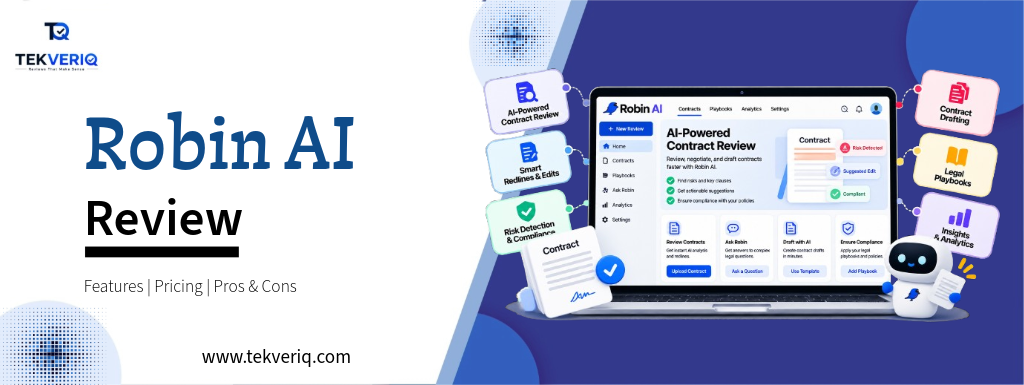
Introducing Robin AI, a cutting-edge legal intelligence AI tool created to expedite the review, drafting, and negotiation of contracts. It promises to significantly reduce contract review cycles by fusing machine learning with specialised legal datasets and human legal experience.
We examine Robin AI’s fundamental dashboard design and comprehensive feature families in this in-depth guide to demonstrate how it revolutionises legal operations.
1. Quick Verdict & Key Specifications
| Specification | Details |
|---|---|
| Product Name | Robin AI |
| Primary Category | AI-Powered Contract Review & Legal Operations Platform |
| Best For | Corporate legal departments, private equity firms, and growing businesses handling high volumes of contracts |
| Starting Price | Custom enterprise pricing (tiered plans starting around $5,000 to $30,000+ annually depending on scale) |
| Key Standout Tech | Generative AI contract redlining, customized fallback playbooks, semantic contract search, and integrated Microsoft Word add-ins |
| TEKVERIQ Rating | ⭐⭐⭐⭐⭐ (4.7/5) |
2. Robin AI Dashboard and Features
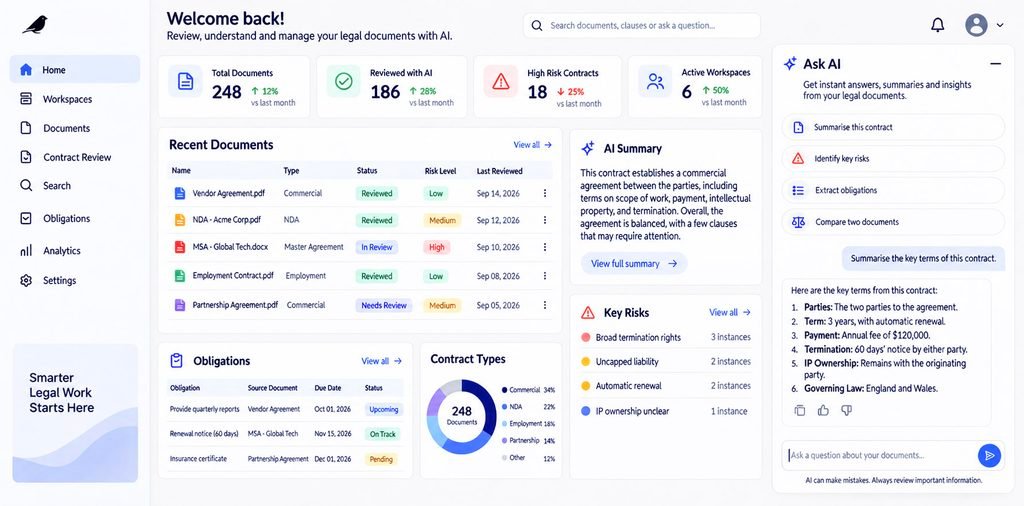
Designed with legal experts in mind, Robin AI’s interface combines an engaging conversational assistant with a clean document workspace. Four specialised function families—Query, Reports, Review, and Draft—are the foundation of the platform’s main dashboard features. These families are intended to cover the full contract lifecycle, from initial draft to post-signature compliance.
1. The Review Family (Risk Scoring & Automated Redlining)
- Playbook-Driven Analysis: To quickly assess terms against organisational risk profiles, users can upload historical files or incoming contracts (such as NDAs, MSAs, and SaaS agreements). The engine determines risk severity scores, highlights high-risk clauses, and finds missing provisions.
- Native Microsoft Word Integration: Robin AI functions seamlessly through a native Microsoft Word add-in (for both desktop and web) rather than requiring attorneys to leave their primary office. With just one click, users may check risk scores, assess automated redline recommendations, and approve or reject revisions. All updates are locally tracked within the document.
2. The Interactive Legal Assistant, or Query Family
- Conversational Document Chat: The query assistant enables legal teams to have direct conversations with individual contracts or entire portfolios thanks to sophisticated large language models that have been refined on legal data.
- Accurate Responses on Request: Users can ask specific questions, such as “What is our liability cap in this agreement?” or “Does this vendor contract permit automatic renewal?” and get prompt, fact-based responses.
3. The Reports Family (Obligation Tracking & Repository Search)
- Semantic Contract Database: A database of previous and current agreements is kept on the central dashboard. Beyond simple keyword matching, our AI-powered semantic search allows users to filter files based on intricate conceptual criteria (e.g., discovering all change-of-control or IP assignment clauses quickly).
- Bulk Cross-Contract Analysis: To reduce compliance risks, legal operations teams can create comparative reports across hundreds of documents at once, monitoring post-signature obligations, renewal dates, and expiration milestones.
4. The Custom Playbooks and Draft Family
- Context-Aware Generation: To cut down on time spent staring at a blank document, the drafting tool creates contract language from scratch or templates based on transaction context, counterparty details, and industry type.
- Custom Playbook Training: To ensure uniform clause standards throughout various business divisions and regions, organisations can incorporate corporate preferences, backup positions, and jurisdiction-specific regulations into bespoke playbooks.
5. Hybrid AI + Legal Services
- Model Human-in-the-Loop Support: To guarantee human oversight on specialised drafting duties, Robin AI connects automated software with an internal staff of knowledgeable legal professionals for intricate negotiations and large transactional workflows.
3. Robin AI Pricing and Plans
Robin AI primarily operates on an annual subscription tier scaled by enterprise volume and feature sets.
| Plan | Price (Billed Annually) | Key Features | Best Suited For |
|---|---|---|---|
| Standard / Reports | Custom (Starts ~ $5,000+ / year) | Core contract repository search, summary tools, light document analysis | Small-to-mid-sized legal teams |
| Enterprise / Pro | Custom (~ $30,000 – $50,000+ / year) | Unlimited contract reviews, custom playbooks, MS Word integrations, SSO | Mid-to-large corporate legal departments |
| AI + Legal Services | Add-on Pricing | Combination of software access and outsourced review/negotiation support from human lawyers | Teams needing supplemental legal manpower alongside tech |
4. Pros and Cons
Pros
- Built Specifically for Legal Context: Fine-tuned explicitly for legal agreements and contract risk evaluation rather than general-purpose textual content technology.
- Drastically Speeds Up Turnaround: Reduces preliminary contract evaluation time by as much as 60–70% on preferred agreements.
- Custom Playbooks: Adapts intelligently to your agency’s unique fallback positions in place of imposing rigid, generic regulations.
- Human-in-the-Loop Backup: Unique hybrid offering offers groups the right of entry to real legal experts for introduced protection.
Cons
- Custom Pricing Gaps: Lack of obvious public pricing tiers means corporate groups ought to undergo sales consultations.
- No Month-to-Month Option: Subscriptions require strict annual commitments.
5. Robin AI Alternatives
While Robin AI is an effective contender in legal tech, numerous options cater to special organizational needs:
- Ironclad: A dominant enterprise contract lifecycle management (CLM) platform focused closely on end-to-end workflow automation and digital contracting workflows.
- Luminance: An AI-powered contract analysis device built for M&A due diligence, file era, and repository monitoring.
- Harvey AI: An enterprise-profile legal generative AI platform tailored extensively for pinnacle-tier law corporations and comprehensive legal studies.
6. Third-Party Platform Rating
| Review Platform | Verified Rating | Total Reviews Analyzed | Key User Highlights |
|---|---|---|---|
| G2 | 4.6 / 5 ★ | 50+ Reviews | Praised for cutting-edge contract redlining accuracy, time-saving capabilities, and smooth Microsoft Word integrations. |
| Capterra | 4.5 / 5 ★ | 30+ Reviews | Highly rated for interface efficiency and seamless document handling, though users note enterprise setup requires onboarding time. |
| Trustradius | 8.8 / 10 ★ | 25+ Reviews | Noted as an innovative tool for shifting legal workloads from manual review to high-level strategic negotiation. |
7. Final Verdict
TekveriQ Final Score: 4.7 / 5
If your crew is weighed down by heavy agreement volumes, tedious redlining cycles, and manual threat assessment, Robin AI is a high-quality solution. By bridging the gap between automated intelligence and tailor-made company playbooks—with optional human criminal backing—it transforms prison operations from a bottleneck into an acceleration accelerator.
Final Recommendation: Highly encouraged for mid-to-large establishments, non-public equity groups, and felony teams searching for secure, specialized settlement intelligence.